How Brier Scores Quantify the Humility Behind Good Judgment
Calibration is humility quantified. It punishes both false certainty and timid probability.

The Illusion of Agreement
In 1961, US President John F. Kennedy faced a decision that would shape the Cold War. His military and intelligence advisers presented a plan to invade Cuba which relied heavily on a “spontaneous uprising” of the Cuban people in support of the mission. Everything depended on this assumption. Without it, the mission would fail. The intelligence reports described the probability of an uprising as a “fair chance.” To President Kennedy and his political advisers, that sounded encouraging. Humans naturally convert words into internal numbers, and “fair chance” felt close to 60 percent or 70 percent. It felt actionable.
To the military and intelligence officers the same phrase meant something very different. In their internal vocabulary “fair chance” was around 25 percent. It described a shot in the dark rather than a good prospect. The two groups used the same language but lived in different probability worlds. The invasion proceeded. The uprising never happened. The Bay of Pigs became a diplomatic failure that destabilized the administration and contributed to nuclear tensions that followed later that year. The episode was not simply a failure of intelligence collection. It was a failure of information transmission.
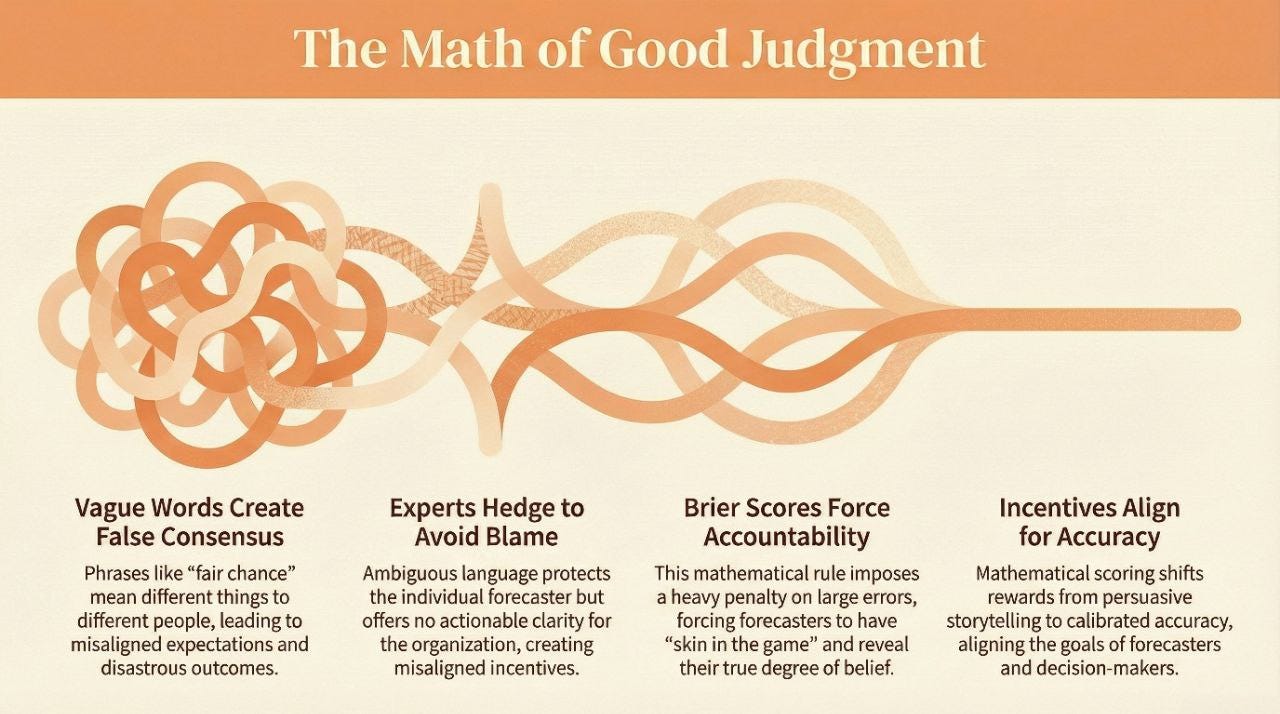
The deeper culprit was a category of terms known as Words of Estimative Probability. These include “likely,” “plausible,” “serious possibility,” and similar phrases that offer narrative comfort without numerical clarity. They create a semantic fog in which experts protect themselves from being wrong while decision makers hear what they want to hear. This is the phenomenon of illusory consensus.

Ambiguity as a Strategy
From a behavioral perspective, Words of Estimative Probability (WEPs) are a psychological shield. Experts rely on Words of Estimative Probability even when numbers exist because they are designed to minimize regret. When an analyst says an outcome is a “real possibility,” the statement protects every future scenario. If the event occurs they can say they warned of it. If it does not occur they can say they never implied it was likely. The language maximizes personal safety while minimizing institutional clarity.
This produces a classic agency problem. The expert benefits from widening the prediction interval, yet leaders need a narrower estimate of risk to make decisions. When incentives diverge, language drifts toward strategic vagueness. The safest move in many bureaucracies is to say everything could happen and nothing is ruled out.
Organizations amplify this problem by rewarding narrative plausibility. Humans respond to confidence and persuasive storytelling. In many boardrooms the most compelling speaker wins the intellectual contest even when their record is weak. The charismatic artist thrives while the cautious forecaster is treated as indecisive. Rhetoric displaces probability. This tension reveals a structural problem rather than a cultural one. To resolve it we need a mechanism that rewards accuracy instead of performance. That brings us to the mathematics of accountability.
The Mathematics of Accountability
Forecasting needs discipline. Prediction must shift from art to mathematics. The Brier Score provides this discipline. It is a scoring rule that measures the accuracy of probabilistic predictions and penalizes hedging by design. In the following equation ft is the forecasted probability and ot is the actual outcome coded as 1 or 0:
A perfect forecast yields zero. Larger scores reveal misalignment between belief and reality. The magic of this formula lies in the squared term. It imposes a quadratic penalty rather than a linear one. Small errors are manageable and large errors are costly.
Consider the analyst who predicts 0.5 (50%) for everything. Their Brier Score will be 0.25 regardless of the outcome. They remain mathematically safe yet strategically useless.
Consider the risk taker who predicts 0.80 on intuition and is wrong. Their score becomes 0.64 which is a substantial penalty. The math exposes whether their confidence reflects evidence or optimism. The rule forces a bet. Analysts must reveal their true degree of belief because the cost of exaggeration becomes visible.
This shifts the incentive structure. The analyst wants a lower Brier Score. The leader wants a forecast aligned with reality. The mathematical penalty brings these incentives closer together.
Calibration in Practice
Public policy environments should reward sharpness. During the global COVID pandemic, high profile predictions dominated the policy space because they offered clarity in a moment of fear. Forecasts with narrow confidence intervals looked decisive. Yet narrow intervals reflect sharpness, not calibration. A forecaster who assigns 95 percent probability to a surge every month will eventually be wrong with significant cost. Policy institutions often reward the boldness but the Brier Score penalizes It.
Business strategy suffers from the same distortion. Corporate demand forecasts are frequently presented with strong conviction. Executives reward confident projections even when the track record is poor. Imagine a sales meeting in which a business executive claims a product launch is a “sure thing.” In the current system the room responds with nods. In a calibrated system the CEO asks for the track record. A claim of ft close to 1.0 carries a potential penalty of the maximum possible score if the outcome fails.
The formula pressures the forecaster to slow down and consider the evidence. They might revise the estimate to 0.7 which acknowledges uncertainty without undermining commitment. The correction is not about suppressing confidence. It is about forcing honesty. This shift builds a culture where confidence earns its place rather than iimpersonates expertise.

Conclusion: From Narrative to Quantified Accountability
Forecasting will always involve uncertainty. The goal is not to eliminate unpredictability but to respect it. Calibration is the discipline that turns uncertainty into usable structure.
Institutions need to reward calibration rather than charisma. Forecast teams should be evaluated by average Brier Scores across time and scenarios. Decision makers should stop asking whether something is “likely” and begin asking for the numerical estimate and the calibration record behind it.
It might feel colder and more mechanical but the Bay of Pigs taught a simple lesson. The warm reassurance of vague language is one of the most dangerous comforts in decision making. Confidence without consequence is cheap. Calibration is the currency that builds trust in predictions that match reality rather than performance.