Crystal Ball Tools to Tame Complex Choices
The strategist designs for uncertainty, not against it.

Introduction: The Myth of the Crystal Ball
Imagine two decision makers standing at the edge of uncertainty. A CEO must decide whether to enter a volatile new market and a policymaker must determine how to respond to rising war risks in a fragile region. Both face the same fundamental challenge: acting without certainty. Each must act without full knowledge, balancing judgment, timing and consequence while knowing that no analysis can eliminate risk.
Now step back to the late 2000s. You’re the CEO of BlackBerry, once the symbol of innovation and executive prestige. Your devices dominate corporate communication and your market share is unrivaled. Then Apple unveils the iPhone, a touchscreen device that seems fragile, impractical and aimed at consumers, not professionals. You dismiss it as a novelty. The physical keyboard feels irreplaceable, security is your strength and enterprise clients seem loyal. Yet while BlackBerry refines what already works, the world changes faster than its models can adapt. The company mistook stability for strategy and certainty for clarity. What followed wasn’t a failure of intelligence but of imagination, a failure to rehearse the future before it arrived.
Humans naturally seek clarity. We look for certainty even when none exists, often mistaking intuition for structure. The cost of that instinct is high, leading to misplaced confidence and reactive choices. The best strategists design for uncertainty, not against it. They build frameworks that expose assumptions, clarify trade-offs and turn ambiguity into insight.
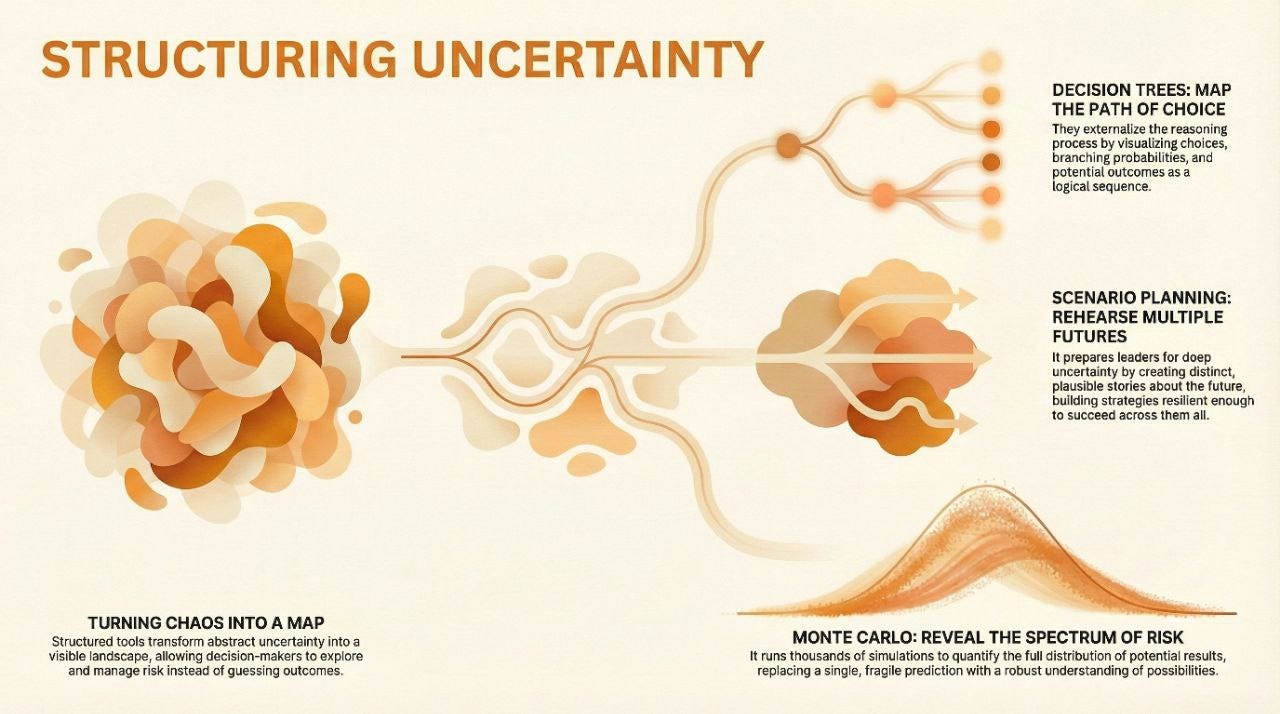
The world of a leader is not one of clean certainties but of shifting probabilities, unknown futures and complex interdependence. When complexity clouds the path forward, leaders don’t need a crystal ball; they need structure. The disciplined response is not to seek perfect foresight but to organize thought. Tools like Decision Trees, Scenario Planning and Monte Carlo Simulations don’t erase uncertainty; they give it shape. Structured tools make reasoning visible, revealing that uncertainty is not emptiness but a landscape that can be mapped, explored and managed. Demanding perfect prediction is futile; building a better map is the mark of a strategist.

Mapping Today’s Decision: Decision Trees and Cognitive Transparency
Decision Trees externalize reasoning by turning intuition into structure. They make internal judgment visible, showing how choices unfold under uncertainty. Each branch represents logic made explicit, forcing clarity about assumptions and outcomes.
A Decision Tree visualizes a decision over time, showing how one choice leads to another through sequences of chance and consequence. Its key parts are:
Decision Nodes (□): Points where a choice must be made.
Chance Nodes (○): Points where an uncertain event occurs, defined by probabilities.
Branches: The paths extending from each node.
Consider a prosecutor managing a complex criminal case. The first decision node is whether to offer a plea deal or go to trial. The plea deal offers a certain but moderate outcome. The path to trial, however, is filled with uncertainty; a chance node appears. Suppose there’s a 70% chance the court admits key evidence and a 30% chance it doesn’t. Each path leads to another chance node: the jury’s verdict. If evidence stands, conviction odds rise to 80%. If suppressed, they drop to 40%.
By mapping these possibilities, the prosecutor can work backward from final outcomes, a long sentence, a short one or an acquittal, and their probabilities to calculate the expected value of going to trial. This yields a logical number to compare it with the certainty of a plea deal. The tree doesn’t make the decision but it turns an intuitive judgment call into a structured process. Intuition becomes traceable logic.
The purpose of a Decision Tree is not to dictate the correct answer but to externalize reasoning. When probabilities and payoffs are displayed, debate shifts from opinion to analysis. It clarifies where uncertainty lies and how much it matters. A decision maker who uses a tree sees the process not as a single leap but as a sequence of linked judgments, each step open to review.
Thinking in Futures: Scenario Planning and Mental Flexibility
Scenario Planning is a form of cognitive rehearsal. It trains decision makers to mentally explore possible futures and stress-test whether their strategies might perform under changing conditions. Beyond defense and national security, corporations use it to anticipate regulatory shifts, trade disruptions or technological shocks.
Decision Trees work best to organize known probabilities. Scenario Planning, by contrast, structures deep uncertainty, the kind where probabilities lose meaning. It doesn’t predict the future; it builds a set of plausible, structurally distinct stories about how the future might unfold.
Imagine aa national security team developing a 20-year foreign policy for a volatile region. Instead of issuing a single forecast, they construct three scenarios:
Scenario A: The Cooperative Rise. In this future, regional powers form a stable economic and security alliance. Trade grows, democratic norms strengthen and peace endures.
Scenario B: The Arc of Instability. In this version of the future, a major state collapses, triggering proxy wars, a refugee crisis and the rise of non-state actors. Rivalries intensify and cooperation erodes.
Scenario C: The Long Stagnation. The region avoids open conflict but faces economic malaise, political paralysis and rising extremism.
The goal isn’t to bet on which scenario is correct but to ask: Which strategic moves would serve our national interest across all three futures? Scenario Planning transforms the illusion of control into disciplined readiness. Where Decision Trees structure the present, Scenario Planning organizes the unknown future. It forces teams to identify fragile assumptions, recognize early warning signals and adapt before crisis strikes. By rehearsing uncertainty, these scenarios help leaders design strategies that remain resilient. The exercise strengthens adaptability, ensuring that strategy survives across multiple futures.
Quantifying the Fog: Monte Carlo Simulations and the Mathematics of Risk
Monte Carlo Simulation serves as a bridge between narrative and numerical reasoning. It connects the stories a decision maker tells about uncertainty with data that test them. By simulating thousands of possible outcomes, it measures how confidence holds up under real-world volatility.
Where Decision Trees clarify discrete choices and Scenario Planning tests alternate futures, Monte Carlo handles complex systems with many moving uncertainties. It reveals the full distribution of outcomes, how often success, loss or survival occur, rather than a single estimate.
Consider forecasting an investment portfolio over thirty years. A traditional spreadsheet assumes a steady 7% return each year. But reality is volatile: markets fluctuate, inflation shifts, bonds rise and fall and external shocks occur. A Monte Carlo simulation models that volatility directly:
Replace the fixed return with a random draw from a realistic range, say between -20% and +30%, each year.
Apply similar variation to inflation and bond yields.
Run thousands of simulations, each representing one possible future.
The outcome is not one number but a distribution. Instead of asking, What will the portfolio be worth?, a strategist asks: What is the probability of reaching one million dollars?
Monte Carlo Simulations show that variability shapes outcomes as much as averages. They quantify fragility and reveal the full spectrum of results. The power lies not in precision but in perspective. A strategist can then design buffers and contingency plans instead of relying on false certainty.

Conclusion: From Prediction to Preparedness
Every major decision involves unknowns, yet structure restores agency. Complexity overwhelms only when it stays invisible. Once mapped, it becomes negotiable. Decision Trees map choices, Scenario Planning tests them against futures and Monte Carlo Simulations show how they behave under volatility. A strategist learns to think in layers, mapping choices, rehearsing futures and testing risk. Each method disciplines a different facet of intuition, bringing analytical depth without suppressing judgment.
Structured thinking is more than a technical exercise; it is a form of intellectual honesty. It demands confronting what is known, what is assumed and what remains uncertain. The disciplined strategist organizes chaos into comprehension, turning doubt into design. A well-built tree, a thoughtful set of scenarios and a rigorous simulation transform uncertainty from an adversary into an ally. The goal is not to predict outcomes but to future-proof judgment, ensuring coherence even when conditions change.
At its best, structured reasoning refines judgment without promising certainty. A true strategist is not one who predicts the future but one who prepares for it with open eyes.