The Price of Wrongful Error in France
Institutions do not optimize for truth, they optimize for the errors that trigger oversight and scandal.

Introduction: The Constraint Against Tyranny
In October 1761, Marc-Antoine Calas was found dead in his father’s shop in Toulouse, a city in southern France. The Calas family was Protestant in a deeply Catholic city, and the story that spread was fast and convenient: Jean Calas had killed his son to stop a conversion. The evidence was weak and the scene was plausibly staged to avoid the religious disgrace attached to suicide, but the local magistrates did not treat uncertainty as a reason for restraint. Under mob pressure, they treated the prospect of a murderer going free as a stain on the community while treating the prospect of condemning the wrong man as an acceptable operational risk. About a year later, Jean Calas was sentenced to be executed after torture, still insisting on his innocence. Years later, Voltaire’s campaign forced the case back into view, the judgment was annulled and the state conceded it had killed an innocent man. This was not merely a story about prejudice. It was a story about a system whose incentives made one error type feel politically intolerable and the other administratively acceptable.
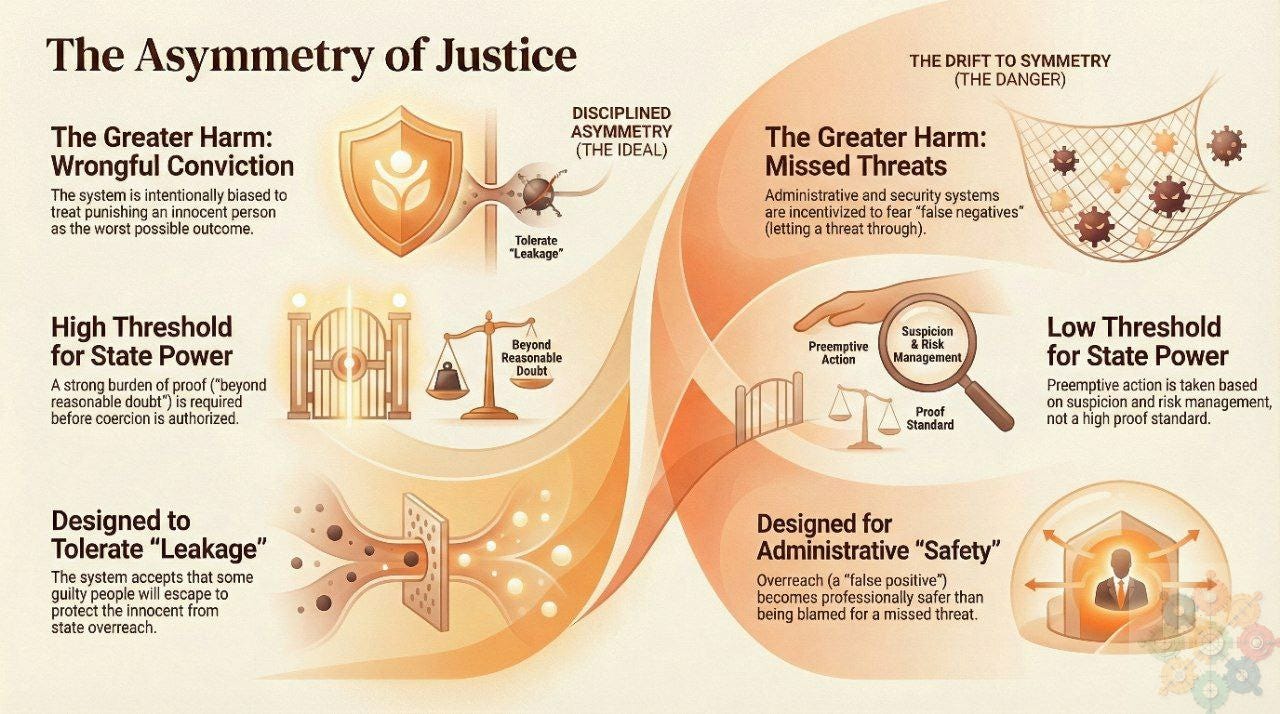
Four years later, William Blackstone offered what is usually read as moral philosophy, but it functions like a design patch: it is better that ten guilty persons escape than that one innocent suffers. That is a constraint, not a slogan. It encodes an asymmetry meant to keep coercion hard to trigger when evidence is incomplete and institutions are tempted to overreach. The tension is that we treat the Blackstone ratio as permanent moral bedrock, when it behaves like an unstable equilibrium. When accountability is asymmetric, institutions drift toward symmetry in practice because symmetry is easy to administer and easy to defend in a crisis. A salient failure occurs, scrutiny punishes misses more than overreach, metrics redefine success as preventing the next shock and thresholds soften quietly. Symmetry then becomes a terror state: a world where the innocent are always close to ruin because the system has decided that caution is too costly.

Risk Weights Inside Verdicts
Blackstone’s line becomes clearer when we stop treating courtrooms as theaters of truth and start treating them as decision mechanism operating under uncertainty, forced to act with imperfect information and public consequences. The true state of the world is whether the defendant is guilt or innocence. The action is whether the system convicts or acquits. The loss function is the penalty the system assigns when action and state do not match. In criminal adjudication the two salient mismatches are familiar: wrongful conviction and wrongful acquittal. Blackstone’s intervention is to deny symmetry at the level that matters most. He is insisting that the cost of convicting an innocent person should be treated as far larger than the cost of letting a guilty person go free, because that is what keeps institutional power bounded when uncertainty is unavoidable.
One disciplined way to express that choice is to evaluate a legal rule by its expected loss:
Where θ is the true state, X is the evidence signal, σ is the rule that maps evidence to an action and L is the penalty the system assigns to error. The leverage sits in L. If the system assigns far larger loss to wrongful conviction than to wrongful acquittal, the rule will demand stronger evidence before it authorizes coercion. That produces leakage, guilty people sometimes escape, but the leakage is not accidental. The system is engineered to tolerate some guilty people escaping because the alternative is a rule that makes coercion too easy to trigger. Justice is not the elimination of error. It is an engineered preference about which error is allowed to happen.
The Administrative Bypass Of Blackstone
The modern shift is not that criminal courts have rejected Blackstone. We increasingly preserve Blackstone’s asymmetry inside the courtroom while circumventing it upstream, in administrative systems that impose serious constraints on lower standards. This is a move from event-based justice, trial after a crime, to state-based management, preemptive restriction under uncertainty. Once the aim becomes risk management, the loss function tilts. A false negative becomes the avoided headline, the avoided hearings, the avoided accusation of negligence. In that environment, overreach becomes reputationally safe and restraint becomes dangerous. The system is not becoming harsher because its agents are worse people. It is becoming harsher because the incentives reward one mistake and punish the other.
The UK’s Terrorism Prevention and Investigation Measures (TPIM) illustrate the structure. Their anti-terrorism measures are framed as protective constraints rather than criminal punishment, and they operate on standards materially below “beyond reasonable doubt,” closer to suspicion-based justification. Lowering the threshold is equivalent to reweighting which mistake the system fears more. It also changes the unit of analysis. The system is no longer judging an individual act. It is screening a population for risk, like border control, sanctions enforcement or financial de-risking. In screening problems, false positives are often treated as cheap, a frozen account, a travel restriction, a flagged name, while false negatives are treated as catastrophic. That is exactly the setting where the ratio drifts toward 1:1 logic, because symmetry is what you get when misses are career-ending and overreach is merely paperwork.
Choosing Our Regret
“Beyond reasonable doubt” is often discussed as if it were an epistemological fact, a natural consequence of what we can know. It is better understood as a public preference encoded into procedure. It expresses how much harm a society is willing to tolerate in order to avoid empowering the state to coerce. From this perspective, many security versus liberty debates are misframed. Many disputes that sound like arguments about facts are arguments about loss weights. An authoritarian posture treats the cost of the missed crime as the dominant failure. A liberal posture treats the cost of state overreach as the dominant failure. The difference is structural and political, a disagreement over which regret is acceptable and which regret must be made hard to incur.
The risk today is not that these weights are debated openly and decided badly. The risk is that they are set implicitly, through protocols, software defaults and bureaucratic discretion, then defended after the fact as “just procedure.” When decision rules are embedded in procedures, checklists and administrative workflows, the public sees only outcomes, not the loss function that produced them. This is where law matters as a clarity tool. Standards of proof, burdens and verification thresholds are not technicalities. They are guardrails that stop every allegation from being treated like a ruin state. Legitimacy is not a moral label. It is a constraint that behaves like a payoff term, because a system that can coerce easily in the short run loses governability in the long run. If we want to preserve Blackstone’s asymmetry, we must make the system’s error preferences legible, contestable and defended as design, not assumed as culture.

Conclusion: The Feedback Loop That Rewrites Justice
A system that catches all guilty actors is not a realistic aspiration. It is a posture that implies expanded coercion, because you cannot drive false negatives toward zero without expanding false positives. Perfect security therefore converges toward infinite restriction. That is the structural lesson of the Calas story: when the system treats misses as the unforgivable outcome, it will manufacture certainty by lowering thresholds, widening nets and making coercion easier to justify. The result will look like competence until it looks like Toulouse.
The rule of law, at its highest integrity, is not maximal enforcement. It is the willingness to tolerate risk, including the discomfort of seeing a guilty person escape, because that discomfort is the premium we pay to keep coercion bounded. To read justice as a loss function is to look at a prevented attack, a frozen account, a widened watchlist and ask what false positives were accepted to achieve that outcome. If that question is not asked, the ratio will be tuned by default. The wheel is what symmetry becomes when power is allowed to optimize without mercy. Justice is not symmetry. It is disciplined asymmetry.