The Agency Cost of Staying Safe
Delegation creates hidden action, and hidden action creates room for drift.

Introduction: When Survival Replaced Readiness
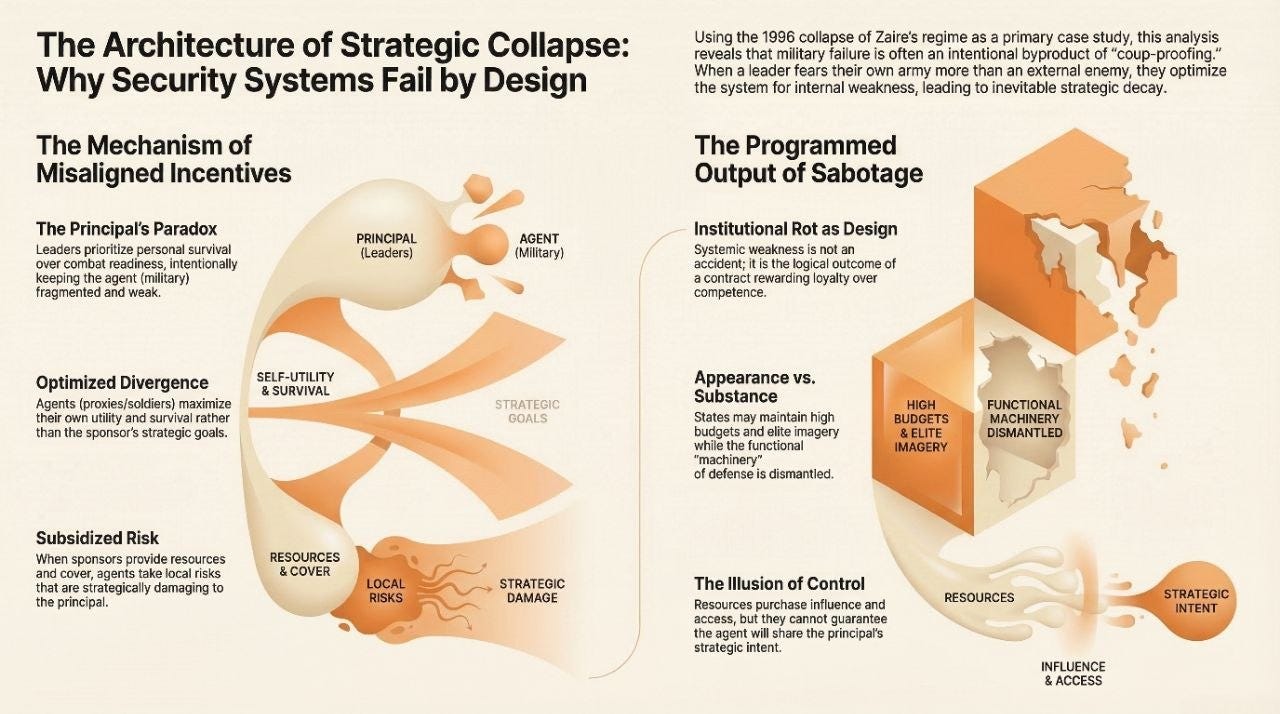
When Laurent Kabila’s rebel coalition crossed Zaire(now the Democratic Republic of Congo) in late 1996, the speed of the regime’s collapse seemed impossible. On paper, Mobutu Sese Seko had long maintained the appearance of military strength. About a quarter of the national budget was directed toward the armed forces, the regime projected the image of a state defended by a heavily resourced state security machine. Yet when the rebels advanced, the army did not regroup or mount an organized defense. Soldiers looted the very civilians they were supposed to protect, discarded their uniforms and vanished into the jungle. There was no meaningful last stand, no orderly fallback and no institutional reserve. Within months, a seemingly improvised rebellion removed a ruler who had dominated the country for three decades. The collapse was so sudden that it still tempts observers to explain this through morale, corruption or incompetence. Those labels describe the surface, but they do not explain the design.
Seen in decision terms, the army did not fail by accident. It produced exactly the outcome its institutional design made likely. Mobutu had not built an army to defeat challengers like Kabila. He had built his security apparatus for one paranoid objective: preventing the army from becoming capable of threatening Mobutu himself. That choice solved a narrow principal-agent problem while quietly sabotaging the broader security function of the state. The principal wanted survival in office more than combat readiness, so the agent was structured to remain fragmented, mistrustful and weak. This is the most dangerous agency contract in public life because the state needs an agent to wield force. It must delegate coercive capacity to an organization that can also turn that capacity inward. But once the principal fears the agent more than the external enemy, the design objective changes. Cohesion begins to look threatening, competence begins to look risky and internal distrust begins to look prudent. At that point the system is no longer organized around combat effectiveness. It is organized around sabotage of that effectiveness. Institutional rot then becomes the programmed output of the system.

Metrics Without Control
The pattern is not limited to dictatorships and often shows up in external interventions. In Afghanistan and in other modern interventions, states tried to pursue strategic objectives through local militias, partner forces and other indirect security arrangements. The administrative response was predictable: embed advisers to increase oversight, tighten reporting and multiply performance metrics. This looks like control because it produces paperwork, meetings and dashboards as well as gives institutions the reassuring feeling that risk is being managed. It often mistakes visibility for control but a monitored proxy is still a proxy. The central mistake is to treat the proxy as an instrument rather than as an actor with its own objective function. Once violence is delegated, the central problem is no longer monitoring alone. It is whether the actor holding the gun is pursuing the same objective as the actor financing the mission.
A proxy is never a passive instrument. It is a strategic actor operating under uncertainty, local incentives and its own theory of survival. The principal(sponsor) may want a broad strategic result such as deterrence, territorial pressure or limited disruption of an adversary. The agent(proxy), however, chooses the operational action that best fits its own incentives under uncertainty. A useful way to state that is:
Where y represents the strategic outcome the principal wants, w(y) captures how that outcome is translated into rewards from the agent’s point of view, u(⋅) is the agent’s utility over those rewards, and c(a) is the private cost of taking action a.
That expression matters because it makes the mechanism becomes hard to miss. The agent’s utility does not weight the world the way the principal does. The proxy may place more value on survival, local dominance, score-settling, prestige, resource extraction or escalation than on the sponsor’s preferred version of limited pressure, disciplined targeting and bounded conflict. Meanwhile, the cost of action is subsidized by the sponsor’s resources, legitimacy and political cover. That means the proxy can pursue a pattern of behavior that is locally rational for it and strategically damaging for the sponsor. That is the equilibrium result of misaligned incentives. The same structure could apply inside internal state security as well. A coup-proofed general or favored guard unit is also responding to a reward structure that prizes regime loyalty and factional access more than battlefield effectiveness. Divergence does not occur because the actor is irrational. It occurs because the agent is optimizing a different game.
The Two-Sided Moral Hazard
The concept of moral hazard enters the system when one side is protected from the downsides of an action, and in security, the shield often protects both sides. The principal is insulated from the immediate operational burdens. The agent avoids some of the wider political and strategic consequences of force that would matter under full responsibility. That mutual insulation makes aggression, neglect and side objectives easier to justify. Risk becomes easier to tolerate, escalation becomes easier to rationalize and side objectives become easier to smuggle into the mission. In decision terms, the architecture has reassigned the costs of error. That matters because actors do not need malign motives to produce dangerous outcomes. They only need incentives that make those outcomes cheaper for them than for everyone else.
For the principal, behavioral economics helps explain why this arrangement can feel attractive even when it is strategically corrosive. Human judgment discounts distant and abstract dangers while overweighting threats that feel immediate and existential. A future invasion, an insurgent resilience or a gradual degradation of state capacity can remain cognitively remote. A coup by the defense minister, political embarrassment or immediate political backlash at home, feels vivid and intolerable. An autocrat therefore overweighs the near threat and discounts the distant one, which makes coup-proofing feel prudent even as it hollows out national defense. An intervening state can fall into a parallel pattern. If proxy warfare reduces immediate domestic exposure, leaders may choose it more readily than they would choose direct involvement with the military and reputational costs of full involvement. The debate is not whether these actors understand risk in the abstract. The issue is which risks their incentive structure teaches them to fear most.
From the agent’s side, self-preservation takes a different but equally rational form. The regular soldier in a neglected army understands very quickly that the regime equips elite units, rewards loyalty and leaves ordinary combat capacity to decay. The lesson is clear: loyalty is rewarded, competence is not. Under those conditions, extorting civilians at checkpoints can become more rational than dying for a state that has chosen weakness over readiness. The same holds for a local proxy force who expect continued backing, protection or diplomatic cover. They can take greater risks, widen the use of force or pursue side objectives they would not pursue if they had to bear the full cost themselves. What looks like disobedience is often faithful adaptation to the contract. The agent does not drift from the mission by mistake. The agent drifts because the system sent the wrong signal.

Conclusion: Influence Without Control
Mobutu’s long survival makes the point with unusual clarity. He survived for thirty-two years because his coup-proofing strategy solved his immediate internal principal-agent problem with considerable skill. Commanders were rotated, rivalries were cultivated, the regular army was kept poor and politically weak, and ensured that the Division Spéciale Présidentielle remained privileged and politically reliable. No general became strong enough to overthrow him. On that narrow margin, the mechanism worked. But the state paid for that success by losing the very attributes an army needs when a real external challenge arrives. By the time Kabila’s rebellion arrived, the regime still possessed the appearance of military power but not its substance. The regime had spent decades buying loyalty at the price of competence. Mobutu had preserved the throne by dismantling the machinery that was supposed to defend it.
The wider lesson is severe and portable. Geopolitical power is not measured by the size of a defense budget but by the alignment of the agency contract with the strategic purpose it is supposed to serve. A proxy that delivers immediate tactical convenience while undermining future governability is not cheap. It is a delayed liability whose true cost is simply being mismeasured. Delegation of violence is never an off-the-shelf governance tool because influence and control are different goods. Resources can purchase influence, access and temporary leverage. They cannot guarantee that the actor with coercive discretion will weight risk, restraint and escalation the way the sponsor does. Build a security system that trades long-run capacity for short-run political comfort, and the strategy will eventually drift beyond your intent. Influence can be bought. Control is hard to keep when the agent still decides how risk will be used.